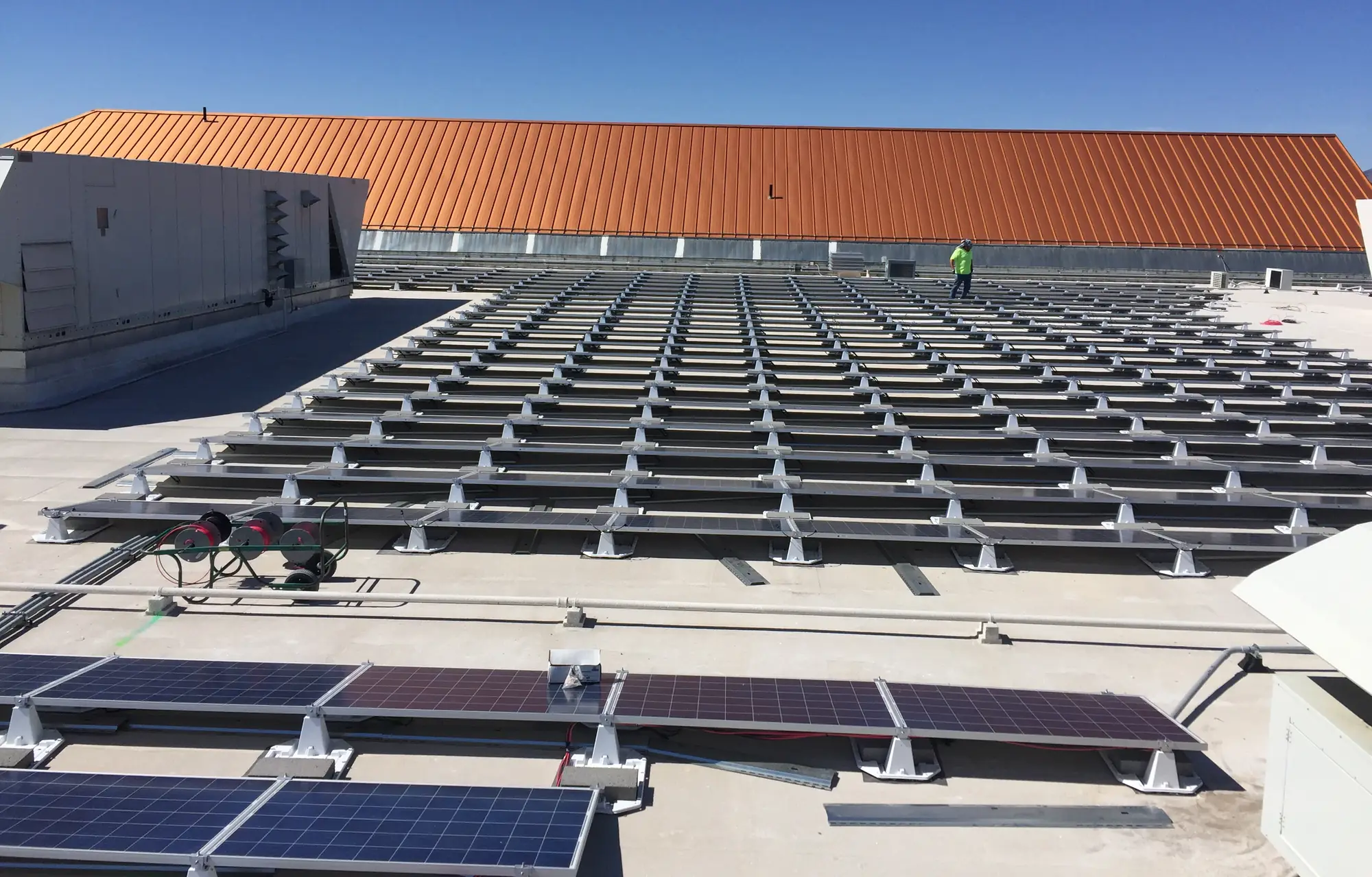
Decide the tilt against your parapet before you compare prices
Ask every installer one question first: how high will the top of the array sit, measured from the lowest ground next to the house? Get the number in writing, then hold it against your parapet and the village's 26-foot cap.
A parapet is the low wall that rises above the edge of a flat roof. Pueblo-style and Territorial houses usually have one, and the village's H zone requires those styles. Tilt is the angle the racks lift the panels off the roof deck. The top-of-array height is where the upper edge of the highest panel ends up.
On a pitched roof, the roof sets the angle. On a flat roof the installer sets it, and in Corrales that choice runs into the village code. Section 18-30 of the Corrales zoning code says: "No building, antenna, and/or structure of any type shall exceed twenty-six (26) feet in height." The code's definitions measure height "from the lowest undisturbed grade adjacent to the structure to the highest point of the structure." The village permit application repeats the cap, "measured to the ridgeline or top of parapet."
On a sloping lot, "lowest" means the downhill side of the house, not the front door. A house that looks modest from the street can be close to 26 feet from its low side.
The code does not say whether a rooftop array counts toward that highest point. Ask the village Building Official, and in the meantime ask installers to design under 26 feet anyway.
The CNET roundup that ranks for this search cites the Department of Energy: panels produce the most on roofs sloped between 15 and 40 degrees. That figure is about pitched roofs. On a Corrales parapet roof, a rack steep enough to reach that range can push the panels above the parapet, the cap, or both. A flatter rack usually produces somewhat less power, so ask each installer for a yearly production estimate at its tilt. Weigh that against what the steeper design adds: possible review, parapet work and drainage changes.
Find your zone: A-1, A-2 or H
The village's 2023 zone map shows most of Corrales as A-1, the southern end as A-2, and the H (Historical area) zone as a small central area around Old Church Road and Corrales Road. Confirm your parcel's zone with Planning and Zoning before an installer draws anything.
| Zone | What the code says about appearance | What to ask |
|---|---|---|
| A-1 (most of the village) | "Architectural requirements. None." | Will the array stay under 26 ft from the lowest grade? |
| A-2 (southern end) | No screening rule for rooftop solar found | The same height question |
| H (historical area) | Territorial, Spanish Pueblo or Southwest Vernacular style; visible exterior changes need a development review permit | Will the array be visible from a public street or place? If so, who applies for review? |
The H zone rule is in Section 18-35 of the zoning code. No alteration of "the exterior features of buildings … subject to public view from any public street, way or other public place" is allowed without "a development review permit by the Commission." That is a Commission approval on top of the building permit.
In the H zone, if the array will show above the parapet, ask who prepares the review application. The Planning and Zoning Commission meets monthly on a Wednesday evening, and we found no published review time, so don't accept an install date that ignores it.
Two points stay open. The code does not say whether a low array fully hidden behind the parapet needs review; ask Planning and Zoning. And the code's rule that rooftop solar be screened, "for example, by raising the parapet," applies only in the O, C and M zones, not in A-1, A-2 or H. If an installer tells an A-1 homeowner the parapet must go up, ask which rule says so.
State law, as EcoGen summarizes NMSA 3-18-32, lets towns restrict solar collectors only in historic districts. That is why visibility matters in the H zone and hardly anywhere else here.
The zone map is also where you confirm the parcel sits inside the village at all. If it turns out to be inside Albuquerque city limits instead, the permit route is different; the Albuquerque page covers that city's process.
Worked example: top of array vs parapet vs 26 feet
Illustrative example. A two-storey Pueblo-style house on a lot that slopes down to the west. From the lowest ground beside the house, the roof deck is 23.5 ft up and the parapet top 25.5 ft. Panels are about 68 × 45 in, with the lower edge about 6 in off the deck. All dimensions are illustrative; the real height comes from the installer's racking drawing.
| Illustrative design | Rise above deck | Top of array | Against the parapet (25.5 ft) | Against the 26-ft cap |
|---|---|---|---|---|
| 25° tilt, panels in portrait | about 35 in | about 26.4 ft | about 11 in above, visible | about 5 in over |
| 10° tilt, panels in landscape | about 14 in | about 24.6 ft | about 10 in below, hidden | under |
The rise is the panel's sloped side times the sine of the tilt, plus the 6-inch clearance.
The steeper design fails twice. It goes over the cap if the array counts, and it shows above the parapet. The 10° design avoids both questions.
Now the same panels on a one-storey house with a 12-ft deck and a 14-ft parapet top (illustrative):
- 25° in portrait: top of array about 14.9 ft. Far under 26 ft, but about 11 in above the parapet.
- 10° in landscape: about 13.1 ft, about 10 in below the parapet.
Here the cap is not the issue; visibility is. In A-1 that is your call. In the H zone, those 11 inches are a change visible from the street, and that needs the Commission's permit.
Ask each installer for the racking drawing with the top-of-array height marked, and check both lines before comparing prices.
What the proposed flat-roof service would deliver here
Lobo Solar is a proposed solar design-and-install service for flat and low-slope roofs in the Rio Rancho area. Coverage of Corrales is proposed and not yet confirmed.
Proposed service. The service would design the array around your parapets, roof drains and roof covering before it prices panels. In Corrales it would add one sheet to the set described on the flat-roof assessment page:
- Height-and-visibility sheet. Your zone, plus the deck, parapet-top and top-of-array heights from the lowest grade, and whether the array shows from the street.
- Roof condition report. Coverings counted, remaining roof life, repairs needed first.
- Mount-method sheet. A ballasted rack sits on the roof, held down by concrete blocks; an attached rack is fastened through the membrane into the structure. The sheet compares added weight, point loads and how each penetration is sealed.
- Drainage plan. How water reaches the scuppers or canales and how the drains get cleaned. A scupper is an opening in the parapet; a canale is the spout that throws water clear of the wall.
- Parapet and stucco detail. How conduit crosses the parapet, how the opening is sealed and who repairs the stucco.
- Solar-only price and $/W on its own line, with roof work and any engineer letter priced separately.
- Responsibility sheet. Who files with the village, Rio Rancho, PNM and EMNRD, and who supplies Form RPD-41341.
The mount sheet matters because a Construction Industries Division rule (14.5.2.8 F NMAC) calls for a New Mexico professional engineer's structural analysis when an array adds more than 5 lb per square foot of dead load, more than 45 lb at one point, more than 200 lb on one framing member, or uses a mount of unique design. A ballasted design can come close to that line, so ask for the racking maker's weight figures, whether your design crosses it, and who pays for the letter.
What to have ready for a Corrales assessment
- Twelve months of PNM bills, to size the system against your use.
- Your zone and a site plan or survey. The village application asks for the zone, the legal description or MRGCD map number, and a site plan. A survey that shows ground levels around the house also helps fix the lowest grade.
- Roof history. Any roof warranty, the last re-roof permit, the covering type, and whether coatings were layered over each other.
- A photo of the street side of the roof, if you are in the H zone.
- Any subdivision covenants. Planning and Zoning says the village does not enforce private covenants, so a covenant is a separate check. Per EcoGen's summary of NMSA 3-18-32, a covenant made after July 1, 1978 that effectively bans solar collectors cannot be enforced.
Two offices: the village first, then Rio Rancho
Rooftop solar in Corrales goes through two governments: the village for zoning and the building permit, the City of Rio Rancho for the electrical permit and inspections. Ask each installer to name both permits and who files each.
- Village construction permit. The Corrales Construction Permit Application (revised July 2026) has a "Solar" box and a separate "Re-Roof" box. It asks for the zone, legal description or MRGCD map number, value of the work, a site plan, the contractor's state license number and a Village of Corrales business registration number. "Zoning approval must be obtained, with signature, on the application."
- Plans by email, as PDF. Drawings go by email to the Building Official. The village's Building Permits & Inspections page says PDF only; inspection requests also go by email.
- Rio Rancho electrical permit. Electrical permits "must be obtained in the City of Rio Rancho Building Department unless directed otherwise by the Building Official," and the village page states that "The City of Rio Rancho performs mechanical, electrical, and plumbing inspections for the Village of Corrales." The form is on the Rio Rancho Building Inspection Division forms page.
- Install, then inspections. Rio Rancho inspects the electrical work. Whether the village also inspects an array that adds no structure is not stated; ask the Building Official.
- Keep the passed electrical final. The electrical final is the inspection that passes the finished system. PNM and the state credit both rely on that inspection record, with its permit number and date.
Permit fees, per the documents posted in November 2026:
| Fee | Amount | Source |
|---|---|---|
| Village: roof-mounted solar | $150 | Village fee sheet (ground-mounted is $250) |
| Rio Rancho: residential PV, 0–10 kVA | $66 | City electrical permit form |
| Rio Rancho: base permit and administration | $33 + $23 | Same form; three inspections included |
| Illustrative total | about $272 | Confirm with both offices before you pay |
Both documents are old: the village sheet is titled as proposed fees from fiscal 2010, and the city form is a 2015 revision. Ask whether the quote includes these fees and at what amount.
The application asks about flood zones; its elevation-certificate rule is written for new construction. If you are in a flood zone, ask Planning and Zoning whether it matters for a rooftop array. If the roof is re-coated or re-roofed first, ask whether the Re-Roof box applies too.
PNM's handoff after the electrical final
PNM serves Corrales; in a 2024 storm, local news reported its outage map covering the whole village. Check the name on your bill, and switch on only after PNM says so.
According to PNM's solar pages as archived in 2026, the installer sends PNM an image of the approved permit tag, and the customer signs the interconnection application. In Corrales the electrical tag would come from Rio Rancho's inspection, so the village permit alone is not enough for this step.
The state interconnection rule, 17.9.568 NMAC, says the utility normally grants permission to operate (PTO), its written go-ahead to turn the system on, within 10 business days after it receives the final electric inspection clearance.
According to PNM's net-metering terms as reported in October 2026, a system whose inverter is rated 10 kW-AC or less banks surplus as kWh credits that do not expire, and PNM pays out the remainder at its energy rate when the account closes. kW-AC is the inverter's output, usually below the panels' kW DC rating, so ask for the AC rating. These terms come from archived pages and EcoGen's summary; confirm them with PNM.
The state credit, and the quote lines that earn none
This is where the height decision turns into money. First, the federal credit is gone: the IRS says the Residential Clean Energy Credit "is not available for any property placed in service after December 31, 2025." A quote that still subtracts 30% for it is out of date.
What remains is New Mexico's New Solar Market Development Tax Credit (NSMDTC): 10% of the eligible cost of an owned system, up to $6,000, under a $30 million statewide yearly cap. A power purchase agreement (PPA), where you buy the power rather than the system, does not qualify. EcoGen's New Mexico incentives page puts a typical credit at about $1,908 and notes that the remaining balance is not published.
The EMNRD credit guide lists costs that do not count. Two hit Corrales flat roofs directly:
- "system visual barrier costs": a parapet raised only to hide a tilted array fits that wording;
- "costs for modification or roof repair to hold solar panels", such as re-coating the roof first.
The guide also wants a building code inspection report "that includes the building code authority's permit number and date of successful passing inspection," and says "An electrical permit is preferred." In Corrales, that is the Rio Rancho electrical final. Keep it.
Per the New Mexico Taxation and Revenue Department, signing Form RPD-41341 lets the seller deduct gross receipts tax on the system's sale and installation. Ask whether the quote reflects it.
The state benchmark is EcoGen's Solar Cost Index for New Mexico, September 2026 Edition: $2.71 per watt, a modeled installed price for an owned, solar-only system before incentives ($19,078 for a typical 7.04 kW system). $/W is the price divided by the system's DC watts. Divide only the solar line, never the whole bid.
Illustrative calculation. Two quotes for the same 7.04 kW DC array on the two-storey house above. All prices are illustrative.
| Line | Quote A: 25° above the parapet | Quote B: 10° behind the parapet |
|---|---|---|
| Solar (panels, racks, inverter, labor) | $19,800 | $19,400 |
| Raise the street-side parapet 12 in | $2,600 | none |
| Re-coat the roof under the array | $1,500 | $1,500 |
| Engineer letter (ballast over 5 lb/sq ft) | none | $700 |
| Total | $23,900 ($3.39/W whole bid) | $21,600 ($3.07/W whole bid) |
| Solar-only $/W vs $2.71 state benchmark | $2.81, about $720 over | $2.76, about $320 over |
| State credit at 10% of the solar line | about $1,980 | about $1,940 |
On the solar line, both quotes sit about 10 cents or less above the benchmark. The difference is elsewhere. Quote A's parapet raise and re-coat earn no credit, and the raise exists only because of the tilt. Quote B carries an engineer letter instead; EMNRD decides whether that counts. Quote A's real extra is $2,600 spent hiding a choice you could have avoided, plus any H-zone review time.
Add each installer's yearly production estimate at its tilt. If the 25° design produces meaningfully more, the raise may still be worth it; make that decision on purpose.
Is solar worth it in New Mexico? Without the federal credit, check three things: a solar-only price near the benchmark, a system inside PNM's 10 kW-AC kWh bank, and roof work you would need anyway rather than work the design created.
Aftercare: drains, re-coats and an orphaned system
A flat roof needs re-coating from time to time, and the array sits in the way: it usually has to come off whenever the covering underneath needs work. In the Facebook thread that ranks for this search, owners describe installers going bankrupt and leaving "solar orphans" with nobody to service the system. We have no figures on how often that happens; the defense is paperwork.
Ask for these in writing:
- A removal-and-reinstall price for the next re-coat, and how long it holds.
- The permits for that day. Taking the array off and putting it back may need a village permit (the application has both a Solar and a Re-Roof box) and a new Rio Rancho electrical inspection. Ask the Building Official before the roofer is booked, and in the H zone put the array back at the height that was approved.
- Drain and scupper access. How a roofer reaches the drains under a ballasted array, and how far rows sit from each scupper and canale.
- Warranty per attachment. Who covers each penetration or ballast pad (installer, roofer or membrane maker), and whether the work affects your roof warranty.
- Who services the system if the installer stops trading, and which documents (as-built drawings, equipment list, monitoring login, the Rio Rancho permit record) let another contractor step in.
Questions to ask before you sign in Corrales
Bring these to every installer; the quote checklist on this site keeps the answers side by side.
- License. What is your Construction Industries Division license class and number? Bidding on PV work needs EE-98, EL-1 or ER-1; check the number on the state's public lookup.
- Top of array. How high will it be from the lowest undisturbed grade, against the parapet top and the 26-ft cap? Have you asked the Building Official whether the array counts?
- Zone. Which zone is my parcel in? If H, will the array be visible from a public street, and who applies for the development review permit?
- Village application. Who signs and submits it with the Solar box ticked, and who holds the Village business registration number?
- Rio Rancho. Who pulls the electrical permit and books the inspections?
- The record. Will I get the passed electrical final with its permit number and date, for PNM and EMNRD?
- Mount and weight. Ballasted or attached? Added weight per square foot? Is an engineer letter needed?
- Drainage. How do rows clear each scupper and canale, and how are drains cleaned?
- Parapet and stucco. How does conduit cross the parapet, how is it sealed, and who repairs the stucco?
- Separate lines. Is solar priced on its own line, with any parapet raise, re-coat or repair and engineer letter listed separately?
- Production by tilt. What is the yearly estimate at your tilt, and at a lower tilt that stays behind the parapet?
- Credits and aftercare. Does the quote assume a federal credit? Does it stay under 10 kW-AC? Will you supply Form RPD-41341? What would removal and reinstallation cost at the next re-coat?
If an installer answers the first three with numbers and named offices, they have already measured your roof against the Corrales rules.