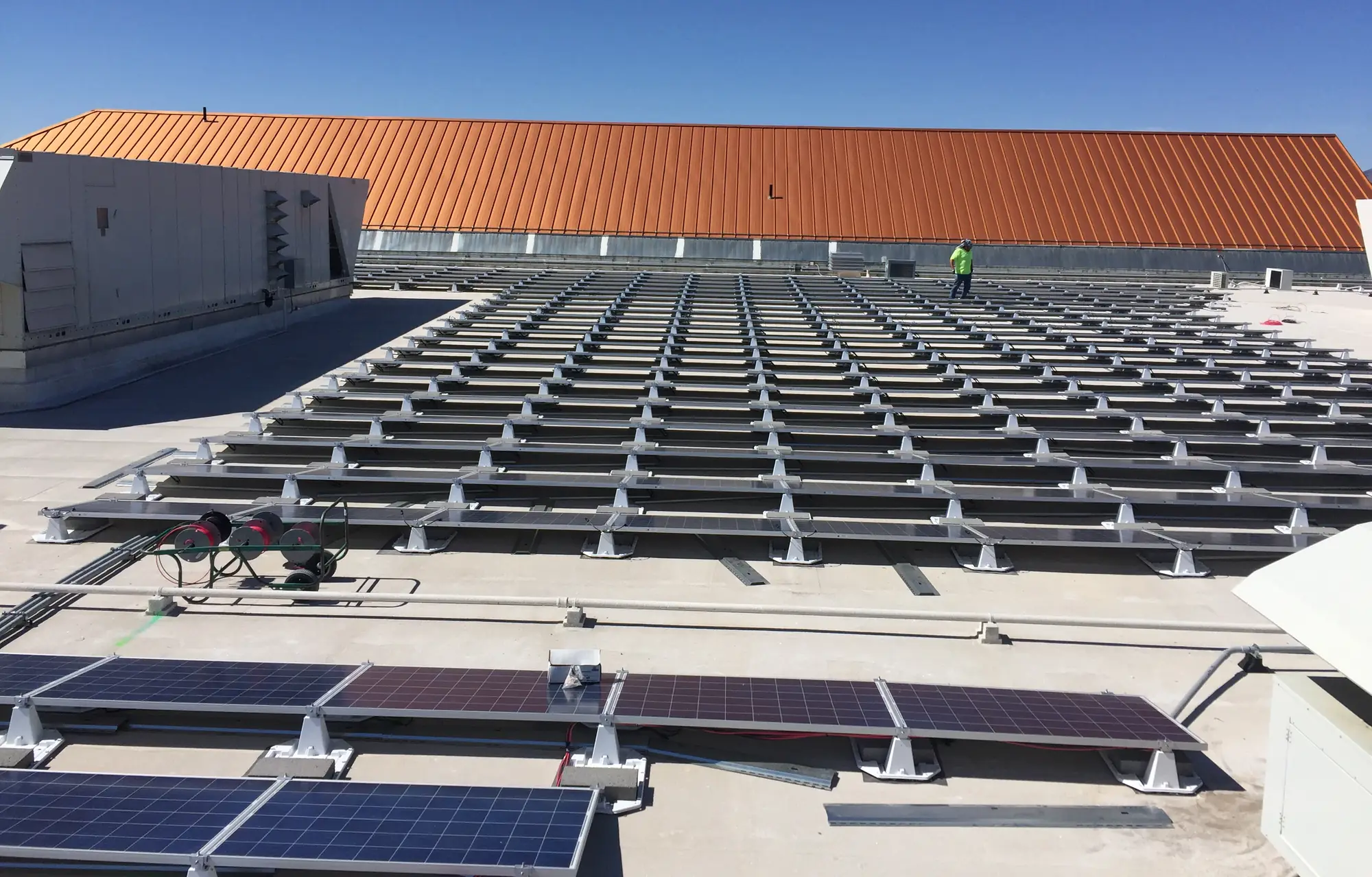
Check your address, then sign the contract the Village will read
First confirm that your home sits inside the Village of Los Ranchos de Albuquerque. The mailing address will not settle it. Village Hall's ZIP code is 87107, and some City of Albuquerque addresses share that ZIP. Your property tax bill should name the taxing jurisdiction; if it does not, ask Village Planning & Zoning. Albuquerque addresses go through the City's permit route instead.
Inside the Village, solar starts with a zone review, the Village's check that a project fits its zoning. The "Application for Solar Panel Zone Review Permit" is on the Village Planning and Zoning forms page.
Read its required documents before you sign anything. The first line reads: "Signed Contract – REQUIRED WILL NOT ISSUE PERMIT WITHOUT FULL DISCLOSURE." The form does not define full disclosure. Read plainly, it means the Village wants to see the whole agreement, not a summary page or a signed estimate. The form also asks for:
- a plat or survey of the lot, drawn to scale;
- the array documents and the array's total square footage;
- the contractor's license number;
- parcel details, including the Middle Rio Grande Conservancy District (MRGCD) map number and the Village "Character Area".
Owner and contractor both sign the application. The possible outcomes are Approved, Approved with Conditions, or Disapproved.
That order changes how you buy. Whatever you sign goes into the permit file. If the mount method, the price split or the permit duties are vague on signing day, they are vague in front of the Village, and changing them later means changing the document the Village already holds.
One more line on the form matters before you sign. The Village "does not take responsibility for information on or enforcement of, restrictive covenants". If your subdivision has covenants or a homeowners association, check them yourself; the zone review will not do it for you.
The Village permit route, in order
"We handle the permits" tells you little in Los Ranchos. Ask the installer to name who does each of these steps, and in which order.
- Roof work first, if needed. A re-coat or parapet repair gets its own contract and permits (next section). Finishing and inspecting it before the solar paperwork goes in is our recommended order, not a written Village rule.
- Solar contract signed, with the final layout, mount method, price lines and permit duties.
- Zone review filed on paper. The Village cannot accept online submittals. Applications go to Village Hall, 6718 Rio Grande Blvd NW, in person on weekdays or in the drop box, with no payment left in the box. Staff call when the invoice and plans are ready.
- Fees at submittal. Under the Village's notice of changes to the permitting process, effective September 1, 2025, fees are due when a complete application is submitted, and any adjustment is collected when the permit is issued.
- Decision: Approved, Approved with Conditions, or Disapproved.
- Electrical permit. Under the state permit rule, the electrical permit for a solar system is issued to a licensed New Mexico electrical contractor once the solar plan submittal, including its calculated added loads, is approved. No page we read says which office issues it for a Village address. Ask at zone review.
- Inspection of the installed system.
- PNM handoff. The installer sends PNM an image of the approved permit tag.
- Permission to operate (PTO): PNM's go-ahead to switch the system on.
The notice adds a deadline that belongs in your contract: an application that needs no public hearing stays active for six months and is void after that if no permit was issued. Ask who refiles, and who pays, if the six months run out on the installer's side.
The forms page also warns about fake emails asking for permit fees. Pay only an invoice that comes from the Village itself.
Fix the roof first, under its own permits
If your home has a flat roof, look at the roof before you look at panels. A flat roof carries a membrane or coating (built-up, modified bitumen, TPO or elastomeric), often behind parapets, the short walls that rise above the roof edge. Water leaves through canales, open channels through the parapet, or scuppers, openings cut into the parapet wall. Panels set on a coating near the end of its life mean taking the array off later to redo the roof.
The Village has a separate permit for roof work. Its Re-Roof Zone Review application asks for two complete sets of plans, a site plan with the building footprint, confirmation that the roof pitch is not changing, the contractor's license number, and a signed contract "used to calculate fees". The form shows a $100 fee; confirm it when you file.
The state adds its own layer. New Mexico's construction permit rule, 14.5.2 NMAC, says "all applications of roof coating systems require building permits and inspections", including a decking inspection and a final.
So give the roof work its own contract. Get it permitted, done and inspected, then file the solar contract. Two things follow. The solar file shows a finished roof, so a change to the roof scope never touches the document the solar zone review holds. And each Village form gets the contract it asks for: a roof contract for the re-roof review, a solar contract for the solar review.
There is a money reason too. New Mexico's solar tax credit excludes roof repair (covered below), so roof costs inside a solar contract earn nothing and blur the claim.
While you are at it, ask for one optional line: what it would cost to remove and reinstall the array the next time the roof needs a coating. That number is cheaper to agree before the panels go up than after.
Ballasted or attached: write the load into the contract
A ballasted array sits on racking held down by concrete blocks, so it needs few or no roof holes. An attached array is fastened through the membrane into the framing. It weighs less, but every fastener is a hole that has to be sealed into the roof covering.
Two load terms decide which one your roof can take. Dead load is the permanent weight the array adds, spread over its footprint, in pounds per square foot (lb/sq ft). Point load is the weight on one spot, such as a single attachment.
The state rule (14.5.2.8 F NMAC) requires analysis by a New Mexico-licensed engineer when a roof array adds more than 5 lb/sq ft of dead load, puts more than 45 lb on one point or more than 200 lb on a single truss, rafter or joist, or uses a unique mount design or over-spanned framing. Reinforcement needs a general building permit with sealed details, and the electrical submittal must include the "calculated added loads".
| Illustrative calculation | Ballasted | Attached |
|---|---|---|
| Panels (16 × 46 lb) | 736 lb | 736 lb |
| Racking and hardware | 160 lb | about 200 lb |
| Ballast blocks | 1,400 lb | none |
| Total over about 330 sq ft | 2,296 lb, about 7.0 lb/sq ft | about 936 lb, about 2.8 lb/sq ft |
| Point load | from the racking report | 36 attachments, about 26 lb each |
| Roof holes | few or none | about 36, each sealed into the coating |
| Engineer analysis | Required: over 5 lb/sq ft | Not triggered by weight; check the load on each joist |
These weights are illustrative. Real figures come from the racking maker's layout for your roof.
The roughly 330 sq ft footprint in this example is also the "total square footage" the Village form asks for. That is why the method has to be settled before signing: the Village reads the contract and the array documents together, and a ballasted layout and an attached layout put different numbers on the same form.
A contract that says "ballasted" with no load figure describes a design nobody has finished. Ask each bidder for the racking report's added dead load and largest point load, and have the contract name the method. If a ballasted design crosses 5 lb/sq ft, price the engineer letter and any reinforcement as separate lines, so they do not hide inside the solar price.
Drainage, parapets and stucco belong in the array documents
Water on a flat roof moves slowly toward a few exits. An array placed without a drainage plan can sit across that path and hold water against the coating. Ask for a roof plan that shows:
- every drain, canale and scupper, with array rows kept clear of each;
- rails raised above the path water takes, not laid across it;
- ponding marks, so nothing heavy sits in a low spot;
- how a person reaches each scupper to clean it later.
Then the parapet. Conduit, the metal pipe that carries the wires, leaves the roof over the parapet cap or through the stucco wall. The plan should show which route, how the crossing is sealed or flashed, and who repairs the stucco if it is cut.
Draw the shade, too. The Village's 2035 Master Plan describes mature cottonwoods as characteristic of the North Valley and the bosque. A tall one on your lot or the next can throw a moving shade line across a flat roof through the day. Ask the designer to mark it on the same plan, measured against the plat the Village already requires.
The zone review form does not ask for a drainage plan or a parapet detail. Ask for both anyway and attach them to the array documents, so the contract, the drawings and the plat all describe the same roof.
What a fair solar-only price looks like
Quotes are compared on price per watt ($/W): the price divided by the array's DC watts, the panels' direct-current rating (panel wattage times panel count). On a flat roof, a whole-contract $/W misleads, because roof work hides inside it.
The New Mexico yardstick is $2.71/W (State benchmark) from the EcoGen Solar Cost Index for New Mexico, September 2026 Edition, prices as of September 25, 2026. It is a modeled installed price for an owned, cash, solar-only system before incentives, not a quote.
Use it only on a solar-only number. The EcoGen Solar Database warns against comparing a solar-only cash benchmark with a battery-inclusive or financed quote without accounting for the difference. Strip out roof repair, an engineer letter and any electrical panel upgrade first. A battery goes on its own line and stays out of the check.
Illustrative example: one Los Ranchos flat roof, two ways to write the contract. Sixteen 400 W panels make a 6,400 W DC array. The roof needs a new elastomeric coat, a parapet cap repair and a resealed scupper first.
| Illustrative calculation | One blended contract | Roof contract | Solar contract |
|---|---|---|---|
| Re-coat, parapet cap, scupper | $2,400 | $2,400 | none |
| Solar: panels, racking, inverter, labor, design | $18,240 | none | $18,240 |
| Total | $20,640 | $2,400 | $18,240 |
| $/W on 6,400 W | $3.23/W | n/a | $2.85/W |
| Gap to $2.71/W (State benchmark) | 52¢/W | n/a | 14¢/W, about $896 |
| Village filing | One mixed contract in front of both zone reviews | Re-Roof Zone Review plus state roof-coating permit | Solar Panel Zone Review |
Blended, $3.23/W looks like an overcharge. Take the roof out and the solar price is $2.85/W, 14¢ above the State benchmark. That is a gap to ask about, for example what the flat-roof racking or ballast adds, not a reason to walk away. A large gap needs a line-by-line reason. The split works the other way too: roof work folded into a "solar" total can make a high solar price look normal.
What the array might produce. EcoGen's New Mexico production factor is 1,824 kWh per kW per year (State benchmark, Albuquerque reference location). For 6.4 kW that is about 11,670 kWh a year, worth roughly $1,720 in year one at EcoGen's PNM net value of 14.74¢ per kWh (Illustrative calculation, no rate change). A low-tilt flat-roof array and cottonwood shade will change that, so ask for an estimate modeled on your own roof.
No 30% federal credit in 2026; the state credit skips roof work
Is there still a 30% solar tax credit in 2026? Not for a system you own. The IRS says the Residential Clean Energy Credit "is not available for any property placed in service after December 31, 2025." For an owned system switched on in 2026, the federal credit is $0. A quote that still subtracts 30% is out of date.
New Mexico's New Solar Market Development Tax Credit still applies. Per the EMNRD credit guide, it pays 10% of equipment, materials and labor, up to $6,000 per system, within a $30 million yearly cap; applications that arrive after the cap is reached are returned. Three of its rules tie back to the Los Ranchos route:
- Roof work earns nothing. The guide disallows "costs for modification or roof repair to hold solar panels" and structural or surface-protection costs the house would need anyway.
- You need the inspection report, with its permit number and date. A Los Ranchos job can produce more than one permit: the solar zone review, the electrical permit and, if the roof was redone, the re-roof review. Ask now which inspection report EMNRD will get and who will hand it to you.
- There is a window. Apply electronically within one calendar year after the install year; a 2026 install means applying by the end of 2027.
In the example, 10% of the $18,240 solar contract is about $1,824 (Illustrative calculation). Claim on the blended $20,640 instead and $240 of the request (Illustrative calculation) rests on roof work EMNRD disallows. Two contracts keep the claim clean. A power-purchase agreement, where a company owns the panels and sells you the power, gets no state credit.
PNM: the 10 kW-AC line and the permit tag
PNM, the Public Service Company of New Mexico, serves the Village. The Village's 2035 Master Plan says PNM provides electricity for the Albuquerque metro area "including the Village", and the Public Regulation Commission's PNM listing names Albuquerque among its service areas.
According to PNM's solar pages as archived in July and October 2026 (pnm.com could not be reached when we checked; confirm the live terms):
- Inverter 10 kW-AC or less (Small PV): monthly surplus becomes a kWh credit that PNM says never expires; credits left when the account closes are paid at Rate 12.
- Above 10 kW-AC: surplus is paid monthly at Rate 12.
- Application: online; the customer may be required to sign the interconnection agreement.
- The tag: "Have City, County, or State inspect installed system", then the installer sends PNM an image of the approved permit tag.
- The clock: nine months from passing PNM's technical screening to finish the installation.
kW-AC is the inverter's output rating, usually lower than the panels' DC size. A bid near 10 kW can land on either side of PNM's line, so have the contract state the inverter's AC rating.
Los Ranchos differs on one point. PNM's steps name City, County or State inspection, while the Village runs zone review, and none of the pages we read says which of those offices inspects a rooftop array inside the Village. Ask which office inspects and issues your tag, and have the contract name who sends it to PNM. The state interconnection rule sets a $150 application fee for systems up to 25 kW and says PTO normally follows within 10 business days of final electrical clearance.
How the proposed flat-roof service would handle a Los Ranchos job
Lobo Solar is a proposed solar design-and-install service for flat and low-slope roofs; its flat-roof assessment describes the full service. Coverage of Los Ranchos de Albuquerque is proposed and not yet confirmed.
Each written deliverable would map to a Village step (Proposed service throughout):
| Proposed service deliverable | Village step it prepares |
|---|---|
| Paperwork review: PNM bills, roof warranty, number of covering layers, covenants | Address and covenant check |
| Roof condition report with photos and repairs needed | Whether a roof contract and Re-Roof Zone Review come first |
| Mount-method sheet: ballasted vs attached, loads, penetrations, engineer trigger | Method, load and square footage in the solar contract |
| Drainage plan; parapet and stucco detail | Array documents for the zone review |
| Solar-only price and $/W; roof, engineer letter and panel upgrade as separate lines | Clean benchmark check and state credit claim |
| Responsibility sheet: zone review, electrical permit, PNM, EMNRD inspection report, Form RPD-41341 | Who does each permit and tax step |
Form RPD-41341 is the state Taxation and Revenue Department form the buyer signs so the seller can deduct gross receipts tax on a solar sale and installation. The site visit would take about two hours (illustrative duration). Optional lines: roof repair, engineer stamp, panel upgrade, battery, and a remove-and-reinstall quote for the next re-roof.
The order is the point. The proposed service would settle the roof and the mount method first and write the solar contract last, because in Los Ranchos the contract is the first thing the Village reads.
Questions to ask a solar installer before you sign in Los Ranchos
Bring these to every bidder, and add them to the quote checklist on this site.
- Address. Is the parcel confirmed inside the Village, and not assumed from ZIP 87107?
- Roof contract. Is any re-coat, parapet or scupper repair on its own contract, through the Re-Roof Zone Review and the state roof-coating permit, and inspected before the solar contract is filed?
- Mount method. Ballasted or attached, and does the contract say which?
- Loads. What are the added dead load in lb/sq ft, the largest point load and the most weight on one joist? If any crosses 5 lb/sq ft, 45 lb or 200 lb, where is the engineer letter, and is reinforcement priced?
- Array documents. Do they give the total square footage, keep rows clear of drains and scuppers, and show how conduit crosses the parapet and who repairs the stucco?
- Price. What is the solar-only price and $/W on DC watts, with roof work, engineer letter, panel upgrade and battery on separate lines?
- Inverter. What is its kW-AC rating, and which side of PNM's 10 kW-AC line does it fall on?
- Who files what. Who files the zone review, the electrical permit, the PNM application, the inspection report for the state credit and Form RPD-41341?
- Village outcomes. If the Village approves with conditions or disapproves, can the price and layout be revised, or the contract ended, without penalty? Who pays a fee adjustment at issue? What happens if the six-month window runs out?
- License. What is your New Mexico license number? The state rule requires anyone contracting a solar install to hold an EE-98, EL-1 or ER-1 license, with installers holding the matching journeyman certificate (EE-98J, EL-1J or ER-1J). Check it with the state Construction Industries Division.
A bidder who cannot answer questions 3 to 6 before you sign is asking you to put an unfinished design in front of the Village.
What to ask Village Planning & Zoning
Some answers were not published anywhere we could read. Ask the Village directly:
- Electrical permit. Which office issues the electrical permit (and a building permit, if reinforcement is needed) for rooftop solar in the Village, and which office inspects and issues the PNM tag?
- Fee. What does the Solar Panel Zone Review cost? The form prints no fee.
- Engineering review. Does a rooftop array go to Village engineering review? The notice says projects that do pay 75% of the quoted review cost before review begins.
- Height. Does any zoning rule limit rooftop equipment in your Character Area?
- Flood area. If a battery, inverter or disconnect would sit at ground level, is your parcel in a mapped flood area?
- Historic. The Master Plan lists four registered historic properties and one district, Los Poblanos. No Village design review for solar turned up on the forms page or in the Master Plan; ask whether any applies to your parcel.
Write the answers into the contract's responsibility list. These are the Village's answers to give, and a bidder's guess is no substitute.